
A multivitamin isn't a magic pill, and it isn't useless either — the honest answer sits in between, and it depends more on what's on your plate than what's in the bottle.
Written by Vita Globe Editorial Team | Reviewed against peer-reviewed research and NIH guidance
Quick Answer
For most healthy adults eating a varied diet, a multivitamin is unlikely to meaningfully change your risk of heart disease, cancer, or death — the largest reviews of the evidence find "little or no effect" on those outcomes[1]. But it isn't pointless: a large randomized trial found a modest reduction in cancer diagnoses in men[2], and a separate trial found a memory benefit in adults 60 and older equivalent to roughly three years of slowed age-related decline[3]. Multivitamins matter most as a backstop for people whose diets or life stage make gaps more likely — not as a substitute for eating well.
In This Article
What's Actually In a Multivitamin
Who Actually Benefits, According to NIH
What the Big Trials Found
What a Multivitamin Won't Do
Bottle vs. Pouch: Same Formula, Different Format
How to Choose One Without Falling for Marketing
Frequently Asked Questions
Sources
What's Actually In a Multivitamin
"Multivitamin" isn't a regulated or standardized term — formulas vary a lot between brands. As a baseline, Vita Globe's Adult Multivitamin Gummies pack nine essential vitamins, plus zinc and iodine, into a two-gummy daily serving: vitamin C (60mg), vitamin D (10mcg), a full set of B vitamins, and the two minerals rounding out the formula[4]. That's a general-purpose, broad-coverage approach rather than a mega-dose of any single nutrient — which matches how NIH describes the intent of a typical multivitamin/mineral (MVM) product: filling small, plausible gaps, not replacing food[1].
Who Actually Benefits, According to NIH
NIH's own fact sheet is specific about this, and it's worth taking at face value rather than the version marketing usually tells you. The people most likely to see a real benefit from a multivitamin are those who[1]:
- Don't consistently get enough vitamins and minerals from food — because of a restrictive diet, a limited appetite, or inconsistent eating patterns
- Follow a strict vegetarian or vegan diet, which can make certain nutrients (like B12) harder to get from food alone
- Are pregnant or breastfeeding, when nutrient needs rise
- Are over 50, when nutrient absorption (particularly B12 and vitamin D) can decline
If none of those describe you and you eat a reasonably varied diet, NIH's position is direct: most people should get their nutrients from food and beverages first, and a multivitamin is not required to be healthy[1]. That's not a reason to skip the next section, though — "not required" isn't the same as "no benefit," and the trial data below is more interesting than the average blanket dismissal suggests.
What the Big Trials Found
This is where the research actually gets specific, and it's more nuanced than either "multivitamins are snake oil" or "everyone needs one."
Cancer risk. The Physicians' Health Study II, a large randomized controlled trial of roughly 14,000 male physicians followed for over a decade, found daily multivitamin use was associated with an 8% reduction in total cancer incidence compared to placebo[2]. That's a real, statistically significant finding from a well-designed trial — but it's also a modest effect, it was specific to overall cancer incidence (not any one cancer type), and the trial only studied men, so it doesn't tell us much about women or younger adults.
Heart disease. The same trial found no reduction in cardiovascular events from daily multivitamin use[2], and the U.S. Preventive Services Task Force's 2022 review of the full evidence base concluded that current evidence is insufficient to weigh the benefits and harms of multivitamins for preventing cardiovascular disease or cancer in the general population — technically an "I statement," meaning the research base isn't strong enough yet to make a clear call either way[5]. That same review recommended against high-dose beta-carotene and vitamin E supplements specifically, due to a documented lung cancer risk in smokers taking beta-carotene — a good reminder that "multivitamin" and "high-dose single nutrient" are not the same category of product, and shouldn't be evaluated as if they were[5].
Memory and cognition. The most interesting recent data comes from the COSMOS trial, which randomized over 3,500 adults aged 60 and older to a daily multivitamin or placebo for three years. The multivitamin group showed measurably better memory performance starting around year one, with the effect persisting through the full three years — researchers estimated the benefit was roughly equivalent to three years of typical age-related memory decline, with a more pronounced effect in participants who had cardiovascular disease[3]. This is one of the more rigorous findings in the space specifically because it's a randomized trial, not an observational study, and it's been replicated across more than one COSMOS sub-study[3].
Taken together: the evidence doesn't support a multivitamin as broad disease prevention, but it does support a real, if modest, benefit in specific outcomes (cancer incidence in men, memory in older adults) for specific groups — which is a very different, more honest message than either extreme.
What a Multivitamin Won't Do
Worth saying plainly, since this is where a lot of marketing overpromises: NIH's review found multivitamins have little or no effect on osteoporosis, lung disease, psychiatric conditions, or overall risk of death[1]. A multivitamin will not undo a diet that's consistently low in vegetables, fiber, or protein, and it's not a stand-in for sleep, movement, or medical care. If you're feeling persistently fatigued, foggy, or unwell, that's worth mentioning to a doctor rather than assuming a daily gummy will resolve it — some of those symptoms point to specific, testable deficiencies (iron, B12, vitamin D) that a general multivitamin may or may not adequately correct depending on the size of the gap.
Bottle vs. Pouch: Same Formula, Different Format
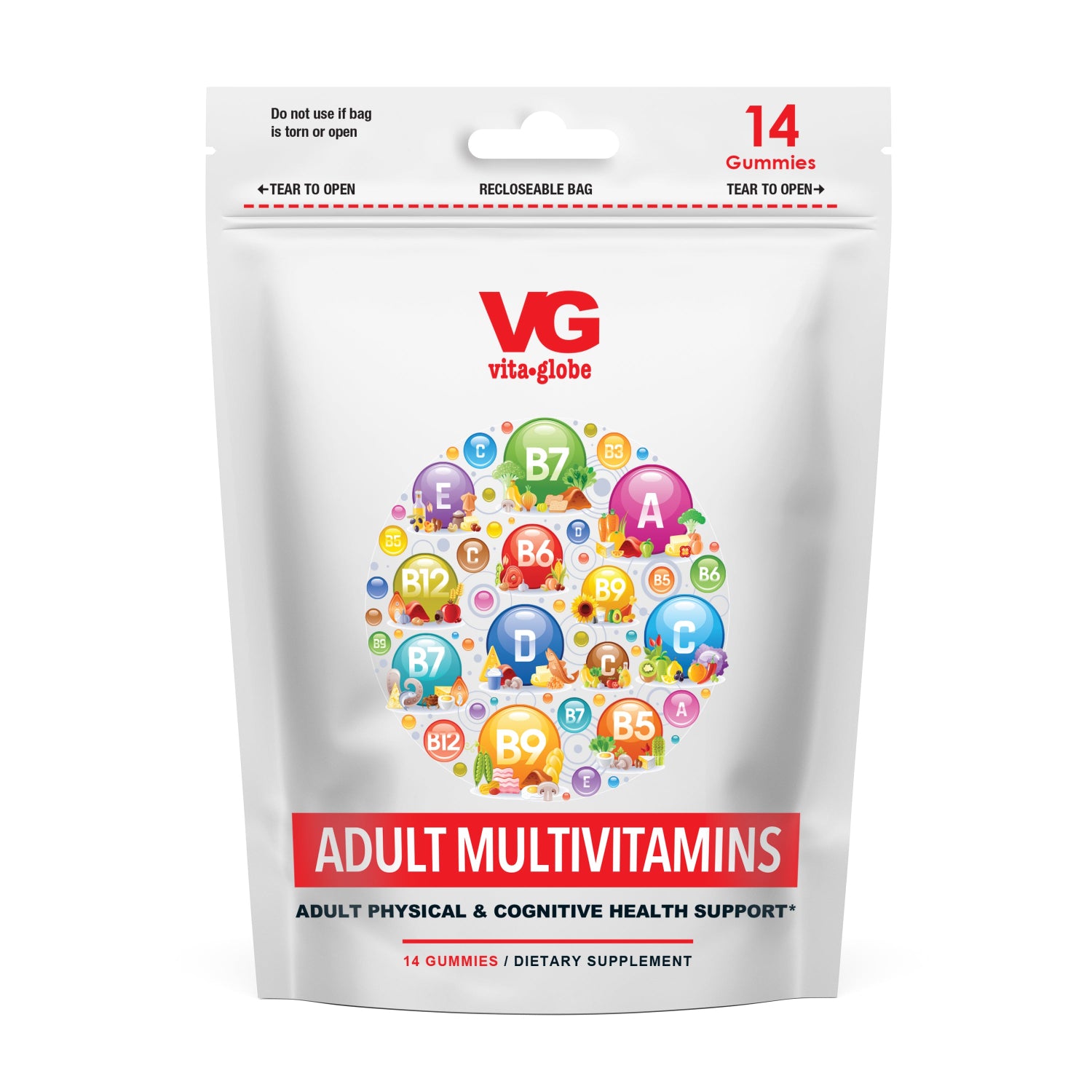
Vita Globe carries two versions of the same multivitamin formula, and they're not competing products — they're the same nine-vitamin-plus-zinc-and-iodine formula in two different formats for two different habits. The 60-count bottle is the standard daily-routine option: two gummies a day, a 30-day supply, meant to live on your counter. The pouch format (14 gummies, also two a day, a 7-day supply) is built for travel, gym bags, or desks — the same formula in a size that doesn't require carrying a bottle. If you go through pouches regularly, the 10-pouch and 24-pouch box options work out to the same per-day cost as buying single pouches one at a time, just fewer reorders.
How to Choose One Without Falling for Marketing
A few practical filters, since "multivitamin" as a category is genuinely inconsistent in quality:
- Skip anything promising to "boost immunity" or "cure fatigue." Legitimate multivitamins support normal nutritional status — they don't treat, cure, or prevent disease, and any product claiming otherwise is overstating what the ingredient research actually shows.
- Watch for mega-doses of fat-soluble vitamins (A, D, E, K), which can build up in the body over time, unlike water-soluble vitamins like C and most B vitamins, which the body simply excretes what it doesn't use.
- Third-party testing (USP, NSF) is a meaningful signal, not a marketing checkbox — the FDA doesn't test supplements for potency or purity before they reach shelves, so an independent seal is one of the few external checks that exists in this category.
- "Once daily" convenience matters more than it sounds — the multivitamin that actually gets taken consistently for months beats the theoretically-more-complete one that gets abandoned after two weeks.
The honest summary
- A multivitamin is not broad disease prevention — NIH's own review found little or no effect on heart disease, cancer overall, osteoporosis, or death risk from typical use[1].
- It's also not useless: a large randomized trial found an 8% drop in cancer diagnoses in men[2], and a separate trial found a real memory benefit in adults 60+, roughly equivalent to three years of slowed decline[3].
- It matters most as a backstop for specific groups — restrictive diets, pregnancy, age 50+, vegan/vegetarian diets — not as a substitute for eating well.
Our Option
Adult Multivitamin Gummies – 60ct — the everyday-routine option: nine essential vitamins plus zinc and iodine, two gummies a day, 30-day supply.
Adult Complete Multivitamin Gummies – Pouch — the exact same formula, packaged for travel, gym bags, or a desk drawer; 14-count single pouches or multi-pouch boxes for less frequent reordering.
Frequently Asked Questions
If I already eat well, is there any downside to taking a multivitamin anyway?
Generally no. NIH's review notes that multivitamins at standard doses are unlikely to cause harm for most healthy adults[1]. The main exception is if a formula includes high doses of fat-soluble vitamins or specific nutrients you're already getting plenty of from food or other supplements — which is a good reason to actually look at what's in a formula rather than assuming "multivitamin" always means "safe at any dose."
Do gummy multivitamins work as well as pills?
The vitamins and minerals themselves work the same way regardless of delivery format. The practical difference is what you'll actually take consistently — a gummy that gets taken daily beats a pill bottle sitting unopened in a cabinet. Gummies sometimes contain small amounts of added sugar for taste and can be harder to formulate with certain minerals (like iron) at meaningful doses, which is why some multivitamin gummies leave iron out — worth checking a label if iron intake is a specific concern for you.
Is it better to take a multivitamin or just eat more vegetables?
Food first, per NIH's own guidance[1] — whole foods provide fiber, protein, and a wider range of compounds that a pill can't replicate. A multivitamin is meant to be a backstop for gaps, not a substitute for a genuinely poor diet.
Why does the label say "9 essential vitamins" if there are also minerals in the formula?
The vitamin count and the mineral count are just tracked separately by convention — zinc and iodine are minerals, not vitamins, so they're not counted in the "9," even though they're part of the same formula and serving.
Should I take a multivitamin in the morning or at night?
Timing doesn't meaningfully change how your body uses a standard multivitamin — pick whichever time you're most likely to remember consistently. Taking it with food can help with absorption of the fat-soluble vitamins (A, D, E, K) it contains.
Are the bottle and pouch versions actually the same formula?
Yes — verified against the current product formulations. Same nine vitamins, zinc, and iodine, same two-gummies-daily serving; the only difference is 60-count bottle vs. 14-count travel pouch (and multi-pouch box sizes for the pouch format).
Sources
- National Institutes of Health, Office of Dietary Supplements. Multivitamin/mineral Supplements — Fact Sheet for Consumers.
- Gaziano JM, et al. Multivitamins in the Prevention of Cancer in Men: The Physicians' Health Study II Randomized Controlled Trial. JAMA, 2012.
- Vyas CM, et al. Effect of multivitamin-mineral supplementation on cognitive function: results from the COSMOS-Web ancillary study and meta-analysis of 3 cognitive studies within COSMOS. American Journal of Clinical Nutrition, 2023.
- Vita Globe. Adult Multivitamin Gummies — product formulation and Supplement Facts panel (verified against live product page).
- US Preventive Services Task Force. Vitamin, Mineral, and Multivitamin Supplementation to Prevent Cardiovascular Disease and Cancer: Recommendation Statement. 2022.
Vita Globe Editorial Team
Reviewed for accuracy against peer-reviewed research and federal health sources.
Also available on Amazon: Adult Multivitamin Gummies
These statements have not been evaluated by the Food and Drug Administration. This product is not intended to diagnose, treat, cure, or prevent any disease. The content in this article is for informational purposes only and is not a substitute for professional medical advice.
Related Bundle
Prefer a ready-made routine? See The Family Wellness Bundle, which pairs the adult and kids' daily multivitamin.